Published 9 July 2026 · Updated 17 August 2026 · ~8 min read · By the Phixo team
An email arrives with a familiar red banner: “Critical security alert” or “New sign-in on Windows.” It says Google noticed a login you might not recognise and asks you to review the activity. Your pulse quickens — is someone in your account right now?
Here’s what makes this one genuinely hard: Google does send emails exactly like this. A real new-device sign-in generates a near-identical message. That’s precisely why phishers imitate the Google security alert so heavily — you’ve been trained to trust it. The good news is that real Google alerts follow consistent rules, and fakes almost always break at least one. Here’s how to check in under a minute.
The quick answer
Treat a Google security alert as fake if any of these are true: it comes from an address that isn’t on google.com or accounts.google.com, it threatens to delete or suspend your account within hours, it asks you to “confirm” your password or payment details, or it carries an attachment. The single most reliable move: don’t click anything in the email. Open a fresh tab, type myaccount.google.com yourself, and check your security activity there. If a real sign-in happened, it will be listed. If the email’s warning isn’t reflected in your account, the email is the fake — not the login.
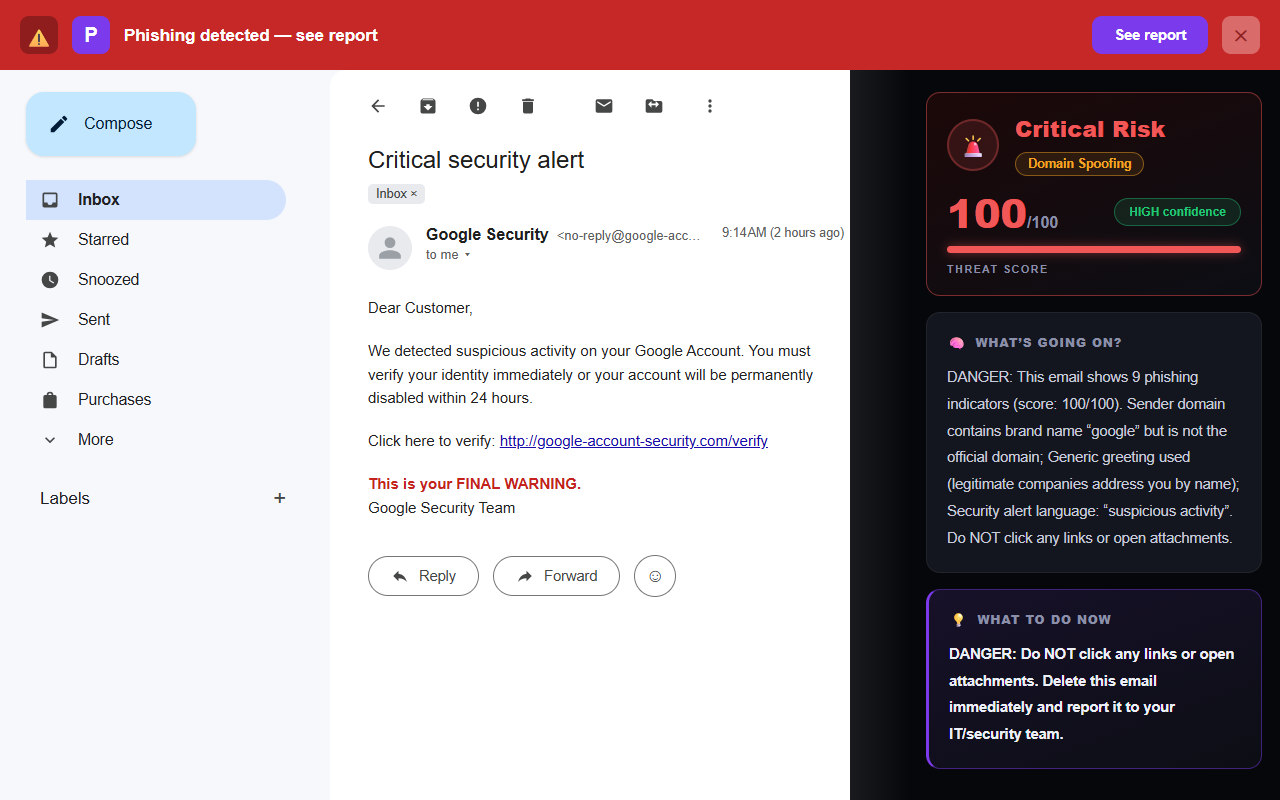
What a real Google security alert looks like
Knowing the genuine pattern makes the fakes stand out:
- It comes from a Google address. Real alerts are sent from an address on google.com — commonly no-reply@accounts.google.com. A domain like google-security.com or account-google-alert.net is not Google.
- It’s plainly designed and calm. Google’s real alerts are simple: what happened (a new sign-in, a new device), roughly when and where, and a single button to review it. No countdown, no threat to delete your account, no all-caps panic.
- It links only to your Google Account. The “Check activity” or “Review devices” button points to myaccount.google.com (or another google.com address), never to a third-party site or a login form on a lookalike domain.
- It never asks for your password. A genuine Google alert doesn’t ask you to type or “confirm” your password, a verification code, or any payment details inside the email. You’re just being told to look.
- It doesn’t rely on an attachment. Google doesn’t attach a PDF, ZIP, or document to a security alert. If the “details” are in a file you must open, that’s a red flag on its own.
Important nuance: receiving a real “new sign-in” alert doesn’t always mean you were hacked. It often fires when you log in on a new phone, a new browser, or after clearing cookies. The alert itself is normal — the danger is a fake one pushing you to a lookalike login page.
6 signs of a fake Google security alert
1. The sender domain isn’t google.com
The display name — “Google,” “Google Accounts,” “Google Security Team” — is trivial to fake. The address behind it is harder. Tap or click the sender name to reveal the full address and read the part after the @.
<no-reply@google-account-security.com>
Real Google alerts come from google.com (typically no-reply@accounts.google.com). Anything with extra words bolted on — google-account-security.com, secure-google.info — is a lookalike, no matter how perfect the logo and colours look.
2. Threats and a countdown
“Your account will be permanently deleted in 24 hours.” “Verify now or lose access.” Real Google alerts don’t work this way — they tell you what happened and let you review it in your own time. Fear that overrides thought is the engine of the attack. If a message is racing you toward a button with a ticking clock, that pressure is the red flag.
3. Links that don’t go to google.com
Before clicking, hover over the button (or press and hold on mobile) to preview the true destination. The text may read “Review activity” while the real link points somewhere else entirely.
Actual destination: http://g00gle-verify-login.com/secure
A genuine Google alert link lives on google.com — the review page is myaccount.google.com. If the destination is a different domain, a shortened URL, or a raw IP address, don’t click.
4. A lookalike domain
The sharpest fakes use domains built to survive a quick glance — a technique called typosquatting, often using homoglyphs (characters that look identical but aren’t).
accounts-google.com (a hyphen, not a real subdomain)
google-security-alert.com (extra words bolted on)
When a domain almost looks right, read it again character by character — especially on a phone, where the address bar is short and easy to skim. Remember: the real security page is always a subdomain of google.com (accounts.google.com, myaccount.google.com), never google.com with a word hyphenated onto the end.
5. It asks you to “confirm” your password or payment
The entire purpose of a phishing page is to capture what you type. A real Google alert only asks you to look. Any “security alert” that routes you to a form for your password, a verification code, or card details should be treated as hostile. Google doesn’t collect those through an alert email.
6. An unexpected attachment
A “security report,” a “sign-in log,” an “account statement” — attachments are a classic malware delivery method, and Google never attaches files to security alerts. Be wary of .zip, .html, and Office files that ask you to “enable content.” If a security alert arrives with a file, that alone tells you it’s fake.
The single safest way to check
Every sign above helps, but there’s one move that beats all of them because it removes the email from the equation entirely: go to your Google Account yourself.
- Don’t click any link or button in the email.
- Open a new browser tab and type myaccount.google.com by hand (or use a bookmark you trust).
- Sign in, then open Security.
- Check Recent security activity and Your devices. A genuine new sign-in will be listed there with the device and rough location.
If the email’s warning isn’t reflected in your account, the email is the fake — not the login. And if you do see a sign-in you don’t recognise, you can sign it out and secure your account from that same page, without ever touching the email.
This one habit — verify by going to the source, never by following the message — defends you against nearly every brand-impersonation scam, not just Google’s. It’s the same principle behind spotting a fake Amazon “account suspended” email.
The 30-second Google alert check
- Does the sender address end in google.com?
- Is it calm, or is it threatening to delete my account?
- Where does the button actually point — myaccount.google.com or elsewhere?
- Is it asking me to type a password, code, or payment detail?
- Is there an attachment? (Google never attaches files to alerts.)
- When unsure — can I open myaccount.google.com directly instead?
Why these fakes fool careful people
Two things make the Google security alert an unusually effective lure. First, it’s a real email you already trust — unlike a random “you won a prize” message, you’ve seen the genuine version and clicked it before. Second, the emotion it triggers is protective, not greedy: the fear that someone is already inside your account makes you want to act right now, which is exactly when careful judgement slips.
A convincing fake will copy Google’s exact layout, colours, and wording. That’s why appearance is the wrong thing to judge on. The reliable tells — the sender domain, the true link destination, and whether the same activity shows up when you log in directly — are the things a scammer can’t fake by copying a template. If you want to read the technical trail an email leaves behind, our free email header analyzer shows you where a message actually came from and whether it passed Google’s own authentication checks.
The exact wording these fake Google alerts use
Scammers reuse a small set of phrasings because they test well — and many people paste the exact line from the email straight into Google to check whether it’s real, which is often how they end up here. If the message in front of you reads like one of these almost word for word, treat that familiarity as the trap, not reassurance:
- “Critical security alert” — or “Critical security alert for your linked Google Account.”
- “New sign-in on Windows” / “A new device is using your account.”
- “Google prevented a suspicious attempt to sign in to your account using your password.”
- “Someone just used your password to try to sign in to your account. Google blocked them, but you should check what happened.”
- “Was this you? If you don’t recognise this activity, your account may be compromised.”
- “Your account will be permanently deleted within 24 hours unless you verify your identity.”
Here’s the catch that makes this scam so slippery: the first few of those lines are copied verbatim from Google’s genuine alerts — the real “Critical security alert” email uses almost exactly that phrasing. The wording alone can’t tell you whether an email is real, because the words are trivial to copy and paste. The last line, though — the deletion threat with a countdown — is something Google never writes, so it’s a reliable giveaway on its own. The dependable tells are the ones a scammer can’t clone: the sender address, the true link destination, and whether the same activity actually shows up when you open myaccount.google.com yourself.
What if you already clicked or entered your details?
Don’t panic — act quickly. Go to myaccount.google.com directly (not through the email) and:
- Change your password straight away, and make the new one unique to Google.
- Turn on 2-Step Verification if it isn’t already on — this stops a stolen password from being enough on its own.
- Review Recent security activity and Your devices under Security, and sign out anything you don’t recognise.
- Check Third-party apps with account access and remove anything unfamiliar.
- Change the password anywhere you reused it. If that Google password protected other accounts, treat them as exposed too.
We’ve written a calm, step-by-step guide for exactly this moment: what to do if you clicked on a phishing link. And to get sharper at catching these before they catch you, see the 8 warning signs of a phishing email.
Frequently asked questions
Does Google really send security alert emails?
Yes. Google genuinely emails you when it notices a new sign-in, a login from a new device or location, or another security-relevant change — usually from no-reply@accounts.google.com. Real alerts are plainly designed, don’t threaten to delete your account, and link only to myaccount.google.com. Because these real alerts are so common, scammers copy them closely.
How can I tell if a Google security alert is real or fake?
A real Google alert comes from a google.com address, uses calm wording, never asks for your password or payment, and links only to myaccount.google.com. Treat it as fake if the sender domain is anything else, if it threatens to delete your account within hours, if it asks you to confirm a password or card, or if it carries an attachment. The safest check is to ignore the email’s links and open myaccount.google.com yourself.
What is the safest way to check?
Don’t click anything in the email. Open a new tab, type myaccount.google.com yourself, sign in, and open Security → Recent security activity and Your devices. If a genuine new sign-in happened, it will be listed there. If the email’s warning isn’t reflected in your account, the email is the fake, not the login.
Is no-reply@accounts.google.com a real Google address?
Yes. accounts.google.com is a genuine Google subdomain, and no-reply@accounts.google.com is one of the real addresses Google uses to send sign-in and security alerts. The catch is that the display name and the visible “from” text are easy to fake, so seeing “Google” — or even that exact address as a label — isn’t proof on its own. Expand the full sender details and read the domain immediately before the final .com: a real one ends in google.com, while lookalikes such as google-account-security.com or accounts-google.com merely contain the word “google.” When in doubt, ignore the email entirely and check your activity at myaccount.google.com.
Is the “Critical security alert” from Google real or a scam?
It can be either — that’s exactly why it works. Google really does send a “Critical security alert” email when it detects a risky sign-in or a blocked attempt using your password, and scammers copy that same subject line and layout almost perfectly. Don’t decide based on the words or the look. A genuine one comes from an accounts.google.com address and its button lands on myaccount.google.com; a fake pushes you toward a lookalike login page, adds a deadline, or asks you to confirm a password. Verify by opening myaccount.google.com yourself rather than trusting the email.
Does Google send security alerts by text message too?
Google can text you a verification code if you’ve set up phone-based 2-Step Verification, but it won’t send you an unsolicited text with a link asking you to “verify” or “secure” your account. Treat a texted link exactly like an emailed one — don’t tap it; open myaccount.google.com yourself. (Phixo checks email in Gmail and Outlook on the web; it can’t see text messages, so verify those by hand.)
Keep reading
- Is that Netflix "payment failed" email real? — Same pressure tactics, aimed at your wallet instead of your login.
- Can you spot the phish? — A fake Google alert is one of the 8 — see if it fools you.
- The 8 warning signs of a phishing email — The full checklist behind every guide on this blog.
- The best anti-phishing browser extensions — The tools that catch emails like this one, compared side by side.
Not sure about an email? Let Phixo check it
Phixo is a browser extension that checks the email open in your Gmail or Outlook against several of the signals above — sender and domain reputation, link mismatches, lookalike domains, and email authentication (SPF, DKIM, DMARC) — plus an AI read of the language, and flags anything suspicious in seconds. Free plan includes 10 scans a day, no credit card. A one-time Google or Microsoft sign-in keeps your scan count tied to your account.
Install Phixo free →Your email body is never stored. Analysis happens in real time and is discarded immediately.